Friday, July 27, 2007

The Best Business Books Ever: The 100 Most Influential Business Books You'll Never Have Time to Read (Paperback)


by Perseus Publishing (Author), Perseus Publishing (Author)

Editorial Reviews
Book Description
From The Art of War to Being Digital-the 100 books that have shaped management thinking and practice.

Given the urgency and immediacy of so many business problems and challenges, a solid grounding in the history and evolution of business thinking will help managers separate fad from fact and apply the cumulative wisdom of the writers whose ideas have demonstrated profound and lasting impact. From Sun Tzu's timeless Art of War to the inventors of modern management in the 1920s-'40s to the books that have the captured the New Economy Zeitgeist, The Best Business Books Ever illuminates the key ideas and contributions of the 100 books that should form the basis of any manager's, business student's, or entrepreneur's library. The Best Business Books Ever places both historical and contemporary works in context and draws fascinating parallels and points of connection between books from different places and times, all of which have contributed to our collective understanding and practice of the art of management.

Book Info
Guide provides a two-page digest of each work; featuring an introduction to the book's key contribution to management thought and practice, an introduction to the main themes, a detailed summary of the most important points, an overview of the immediate reaction to the book and its long-term significance, and bibliographic information for each title. Softcover.

Blue Ocean Strategy: Creating Blue Oceans [DOWNLOAD: PDF] (Digital)


Editorial Reviews
Book Description
In today's overcrowded industries, companies constantly struggle for a share of the market. Competition is fierce--a bloody "red ocean"--and the profit pool is forever shrinking. Introduces a new approach to success by creating "blue oceans"--uncontested market spaces within undefined boundaries. Sets out the basic principles of blue ocean strategy.

Blue Ocean Strategy: How to Create Uncontested Market Space and Make Competition Irrelevant (Hardcover)


by W. Chan Kim (Author), Renée Mauborgne (Author) "A ONE TIME ACCORDION PLAYER, stilt-walker, and fire-eater, Guy Laliberte is now CEO of Cirque du Soleil, one of Canada's largest cultural exports..."

Editorial Reviews
From Publishers Weekly
Kim and Mauborgne's blue ocean metaphor elegantly summarizes their vision of the kind of expanding, competitor-free markets that innovative companies can navigate. Unlike "red oceans," which are well explored and crowded with competitors, "blue oceans" represent "untapped market space" and the "opportunity for highly profitable growth." The only reason more big companies don't set sail for them, they suggest, is that "the dominant focus of strategy work over the past twenty-five years has been on competition-based red ocean strategies"-i.e., finding new ways to cut costs and grow revenue by taking away market share from the competition. With this groundbreaking book, Kim and Mauborgne-both professors at France's INSEAD, the second largest business school in the world-aim to repair that bias. Using dozens of examples-from Southwest Airlines and the Cirque du Soleil to Curves and Starbucks-they present the tools and frameworks they've developed specifically for the task of analyzing blue oceans. They urge companies to "value innovation" that focuses on "utility, price, and cost positions," to "create and capture new demand" and to "focus on the big picture, not the numbers." And while their heavyweight analytical tools may be of real use only to serious strategy planners, their overall vision will inspire entrepreneurs of all stripes, and most of their ideas are presented in a direct, jargon-free manner. Theirs is not the typical business management book's vague call to action; it is a precise, actionable plan for changing the way companies do business with one resounding piece of advice: swim for open waters.
Copyright © Reed Business Information, a division of Reed Elsevier Inc. All rights reserved.

Fort Worth Star Telegram, 14 February 2005
"Companies struggling to stay afloat in the market's...red oceans would do well to look into Blue Ocean Strategy."

Saturday, July 21, 2007

Harry Potter and the Goblet of Fire (Two-Disc Special Edition) (Harry Potter 4) (2005)


Theatrical Release Information

Editorial Reviews
Amazon.com
The fourth entry in the Harry Potter saga could be retitled Fast Times at Hogwarts, where finding a date to the winter ball is nearly as terrifying as worrying about Lord Voldemort's return. Thus, the young wizards' entry into puberty (and discovery of the opposite sex) opens up a rich mining field to balance out the dark content in the fourth movie (and the stories are only going to get darker). Mike Newell (Four Weddings and a Funeral) handily takes the directing reins and eases his young cast through awkward growth spurts into true young actors. Harry (Daniel Radcliffe, more sure of himself) has his first girl crush on fellow student Cho Chang (Katie Leung), and has his first big fight with best bud Ron (Rupert Grint). Meanwhile, Ron's underlying romantic tension with Hermione (Emma Watson) comes to a head over the winter ball, and when she makes one of those girl-into-woman Cinderella entrances, the boys' reactions indicate they've all crossed a threshold.

But don't worry, there's plenty of wizardry and action in Goblet of Fire. When the deadly Triwizard Tournament is hosted by Hogwarts, Harry finds his name mysteriously submitted (and chosen) to compete against wizards from two neighboring academies, as well as another Hogwarts student. The competition scenes are magnificently shot, with much-improved CGI effects (particularly the underwater challenge). And the climactic confrontation with Lord Voldemort (Ralph Fiennes, in a brilliant bit of casting) is the most thrilling yet. Goblet, the first installment to get a PG-13 rating, contains some violence as well as disturbing images for kids and some barely shrouded references at sexual awakening (Harry's bath scene in particular). The 2 1/2-hour film, lean considering it came from a 734-page book, trims out subplots about house-elves (they're not missed) and gives little screen time to the standard crew of the other Potter films, but adds in more of Britain's finest actors to the cast, such as Brendan Gleeson as Mad-Eye Moody and Miranda Richardson as Rita Skeeter. Michael Gambon, in his second round as Professor Dumbledore, still hasn't brought audiences around to his interpretation of the role he took over after Richard Harris died, but it's a small smudge in an otherwise spotless adaptation. --Ellen A. Kim

On the DVD
The highlight of the two-disc set is a half-hour conversation with actors Daniel Radcliffe, Emma Watson, and Rupert Grint. They discuss their reactions to the film and other topics with British writer Richard Curtis . Then they answer questions from contest-winning fans, such as what are their favorite kids' books (Watson bypasses the obvious answer in favor of Roald Dahl and Philip Pullman) and what scenes are they looking forward to in upcoming films. More routine extras include the "Reflections on the Fourth Film" featurette (14 min.), though it has comments from some of the other young cast members, and "Preparing for the Yule Ball" (9 min.). The 10 minutes of additional scenes are mostly skulking and skullduggery, plus a long musical number from the ball. The remaining material is grouped along the lines of the Triwizard Tournament, with behind-the-scenes looks at each of the competitions (about 22 min. total), two longer featurettes on He Who Must Not Be Named (11 min.) and the workday of the other contestants (Robert Pattinson, Stanislav Ianevski, and Clémence Poésy, 13 min.), and four games, playable with the directional arrows on the remote control, that can be frustrating to figure out. --David Horiuchi

Product Description
When Harry Potter's name emerges from the Goblet of Fire, he becomes a competitor in a grueling battle for glory among three wizarding schools - the Triwizard Tournament. But since Harry never submitted his name for the Tournament, who did? Now Harry must confront a deadly dragon, fierce water demons and an enchanted maze only to find himself in the cruel grasp of He Who Must Not Be Named. In this fourth film adaptation of J.K. Rowling's Harry Potter series, everything changes as Harry, Ron and Hermione leave childhood forever and take on challenges greater than anything they could have imagined.
Running Time: 157 min.

Format: DVD MOVIE


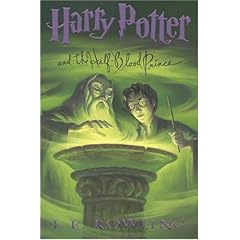
Harry Potter and the Half-Blood Prince


* The introduction of the Horcrux.
* Molly Weasley asking Arthur Weasley about his "dearest ambition." Rowling has always been great at revealing little intriguing bits about her characters at a time, and Arthur's answer "to find out how airplanes stay up" reminds us about his obsession with Muggles.
* Harry's private lessons with Dumbledore, and more time spent with the fascinating and dangerous pensieve, arguably one of Rowling’s most ingenious inventions.
* Fred and George Weasley’s Joke Shop, and the slogan: "Why Are You Worrying About You-Know-Who? You Should Be Worrying About U-NO-POO--the Constipation Sensation That's Gripping the Nation!"
* Luna's Quidditch commentary. Rowling created scores of Luna Lovegood fans with hilarious and bizarre commentary from the most unlikely Quidditch commentator.
* The effects of Felix Felicis.

Harry Potter and the Order of the Phoenix


* Harry's outburst to his friends at No. 12 Grimmauld Place. A combination of frustration over being kept in the dark and fear that he will be expelled fuels much of Harry's anger, and it all comes out at once, directly aimed at Ron and Hermione. Rowling perfectly portrays Harry's frustration at being too old to shirk responsibility, but too young to be accepted as part of the fight that he knows is coming.
* Harry's detention with Professor Umbridge. Rowling shows her darker side, leading readers to believe that Hogwarts is no longer a safe haven for young wizards. Dolores represents a bureaucratic tyrant capable of real evil, and Harry is forced to endure their private battle of wills alone.
* Harry and Cho's painfully awkward interactions. Rowling clearly remembers what it was like to be a teenager.
* Harry's Occlumency lessons with Snape.
* Dumbledore's confession to Harry.

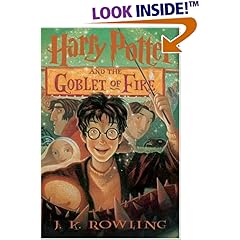
Harry Potter and the Goblet of Fire


* Hermione's disgust at the reception for the veela (Bulgarian National Team Mascots) at the Quidditch World Cup. Rowling's fourth book addresses issues about growing up--the dynamic between the boys and girls at Hogwarts starts to change. Nowhere is this more plain than the hilarious scene in which magical cheerleaders nearly convince Harry and Ron to jump from the stands to impress them.
* Viktor Krum's crush on Hermione--and Ron's objection to it.
* Malfoy's "Potter Stinks" badge.
* Hermione's creation of S.P.E.W., the intolerant bigotry of the Death Eaters, and the danger of the Triwizard Tournament. Add in the changing dynamics between girls and boys at Hogwarts, and suddenly Rowling's fourth book has a weight and seriousness not as present in early books in the series. Candy and tickle spells are left behind as the students tackle darker, more serious issues and take on larger responsibilities, including the knowledge of illegal curses.
Google